ALFA Network WiFi CampPro 3, Dual-Band WiFi 5 (2.4 or 5 GHz) WiFi/Internet Range Extender kit for Caravan, Motorhome, RV, Boat, Yacht Review (2026)
Updated September 14, 2026 · Research-based review
Our verdict
The WiFi CampPro 3 pulls in distant, weak campground WiFi using an outdoor antenna and rebroadcasts it locally inside the RV on both 2.4 and 5 GHz bands. It only strengthens networks that already exist at the site, so it does nothing where no WiFi is available, and setup through a router style interface can confuse non technical users.
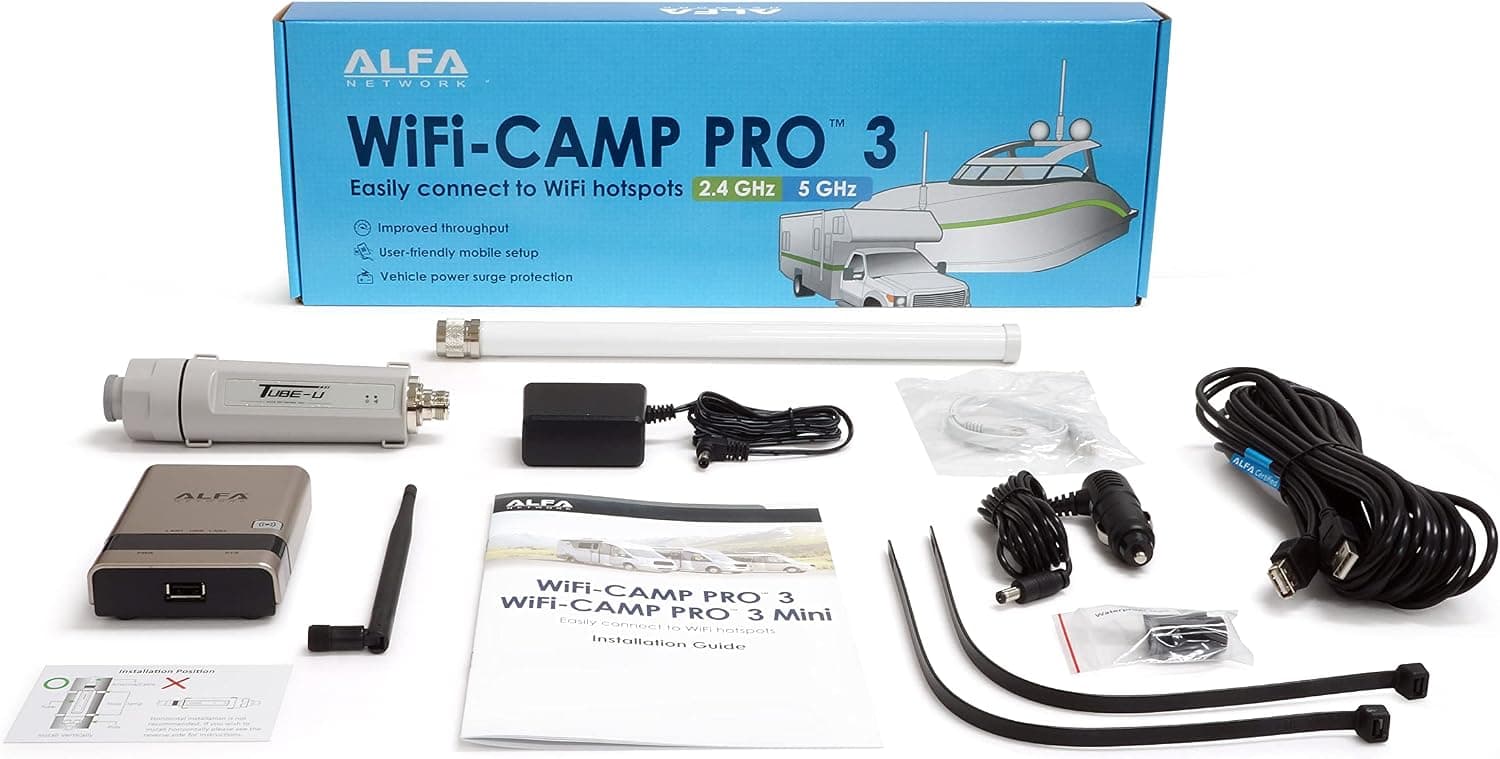
ALFA Network's WiFi CampPro 3, a dual-band WiFi 5 range extender kit for grabbing distant campground WiFi on 2.4 or 5 GHz.
Price range: See on Amazon
What we liked
- + Dual-band support connects to both 2.4 and 5 GHz park networks
- + Outdoor antenna pulls in weak campground WiFi from far across the site
- + Kit is made for caravans, motorhomes and boats, so mounting suits RVs
Trade-offs
- - Only boosts existing WiFi, so it does nothing where no network exists
- - Setup through a router interface can confuse non-technical users
Who actually needs a WiFi booster like this
Campers who regularly stay at parks and campgrounds with WiFi but struggle with weak or unreliable signal reaching their site are the core audience for this kit. Rather than replacing cellular data or providing internet where none exists, the CampPro 3 grabs a distant network's signal using an outdoor antenna and repeats it as a strong local WiFi network inside the rig, the same basic approach long used by marine and RV WiFi boosting kits. Because the kit explicitly supports 2.4 and 5 GHz networks, it fits campgrounds running either older or newer router hardware rather than locking users out of 5 GHz networks the way some budget boosters do. Owners comfortable with basic network setup, logging into a router style admin page to select and connect to a campground network, will get the most out of this kit. Anyone hoping for a zero configuration device should expect a slightly steeper learning curve than a typical cell signal booster.
The three piece hardware kit explained
The kit combines three physical components: an outdoor unit called the Tube-UAC2, a high gain antenna rated at 7 dBi on 2.4 GHz and 9 dBi on 5 GHz, and an indoor unit that creates the local WiFi network and includes two wired Ethernet ports for devices that prefer a physical connection. The outdoor and indoor units connect via an 8 meter USB cable, giving installers flexibility to mount the antenna high on the roof or a ladder while keeping the indoor unit near where people actually use their devices. Dual band support across WiFi 5 standards means the outdoor unit can lock onto either 2.4 GHz networks, which travel farther but carry less bandwidth, or 5 GHz networks, which are faster but shorter range, picking whichever the campground offers. The package includes both a wall socket power adapter and a car style power adapter, covering shore power and off grid scenarios.
Setting up and reconnecting at each stop
Installation starts with mounting the outdoor antenna somewhere with a clear line of sight toward the campground's WiFi access point, typically on a roof rack or ladder, then running the USB cable inside to the indoor unit. Initial setup uses a QR code and a router style web interface to scan for and connect to the campground's network, a process that mirrors setting up a home router more than pairing a phone accessory. Once configured, the indoor unit broadcasts its own local WiFi network that devices in the RV connect to normally, meaning the campground's actual password only needs entering once during setup rather than on every device. Because the system depends entirely on an existing network being present, it is worth testing signal strength at a site before committing to a long stay. Owners moving between campgrounds will need to reconnect to a new network at each stop rather than the system doing this automatically.
WiFi boosting versus cell signal boosting
This kit's closest rival in the same guide is ALFA's own previous generation WiFi CampPro 2, which the CampPro 3 improves on with dual band 5 GHz support, a feature the older model lacks. Cell signal boosters like the weBoost Drive Reach take a different approach entirely, strengthening cellular data rather than WiFi, which matters more at campgrounds with poor WiFi but decent cell coverage. Magnetic cellular antennas from Proxicast and similar brands solve a narrower problem, boosting a specific hotspot device's signal rather than creating a shared network for the whole RV. Against that field, the CampPro 3's advantage is being purpose built for exactly the WiFi boosting job, with hardware and antenna gain matched to that task, while cellular boosters solve a different problem some RVers may need instead or in addition. Buyers should be clear on whether their connectivity problem is weak WiFi or weak cell signal before choosing.
Bottom line for WiFi dependent campers
Choose this kit if your camping trips regularly land you at parks with WiFi that is simply too weak to reach your site reliably, and you are comfortable with a one time router style setup process. The dual band 2.4 and 5 GHz support and RV specific mounting make it a solid upgrade over the previous CampPro 2 generation. Skip it if your actual problem is weak cell signal rather than weak WiFi, since a cellular booster like the weBoost Drive Reach solves that different problem instead. It is also not the right tool for campgrounds with no WiFi at all, since it can only amplify a signal that already exists. For WiFi dependent campers who stay at parks with borderline but present signal, this kit directly addresses that gap.
Frequently asked questions
Does this create internet access where there is none?
No, it only strengthens and rebroadcasts an existing WiFi network, so it will not provide internet at a site with no WiFi available at all.
Does it support 5 GHz networks or only 2.4 GHz?
It supports both, using dual band hardware capable of connecting to either a 2.4 GHz or 5 GHz campground network.
How far apart can the antenna and indoor unit be mounted?
The outdoor antenna and indoor unit connect over an included 8 meter USB cable, giving flexibility to mount the antenna high while keeping the indoor unit accessible.
Is setup difficult for a non technical user?
Setup uses a QR code and a router style web interface to select and connect to a network, which is more involved than plugging in a typical cell booster and may take some patience at first.
Prices change often, so check the current price and availability on Amazon.
Check price on AmazonRV Upgrade Hub may earn a commission from the link above.